After the Whole Bite Club visit, this lesson focuses on personal hygiene, especially caring for our face and mouth. Building on the small-group session — where the Oral Health Home team checked children’s teeth, applied fluoride (with consent), and guided brushing and flossing — students learn that good daily hygiene keeps germs down and helps protect their teeth, and they build these habits into their morning and night routines.
Learning intention
In this lesson, we will learn how to look after our face and mouth every day, and why good hygiene keeps us healthy.
Success criteria
I will know I am successful when I can:
Explain why we practise good hygiene — to keep germs down and stay healthy.
Describe how I look after my face in the morning, for example by washing or wiping my face.
Show how to brush all parts of my teeth and use a small amount of fluoride toothpaste.
Explain why cleaning between our teeth is important.
Guiding questions
How do we look after our face and mouth each day?
What do we do in the morning to get clean and ready?
How does good hygiene help keep germs away?
Vocabulary
hygiene
face
wash
wipe
clean
brush
floss
toothpaste
fluoride
twice a day
swish and spit
germs
Differentiation
Support
Use a printed mouth diagram and a toothbrush to demonstrate brushing, and let students copy the movements in the air.
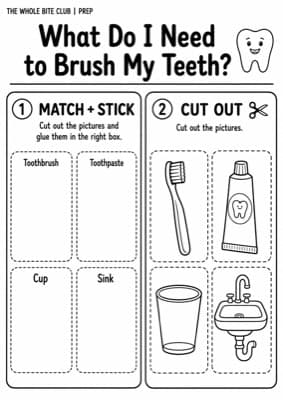
Provide a simple picture sequence of a morning hygiene routine (wash face, brush teeth, and so on) for students to order.
Challenge
Students create a brushing chart to track brushing at home for two weeks.
Students make a “my morning routine” poster or a short demonstration to teach a younger class.
Resources
Foundation – Year 2 Supporting Resource Pack
Printed mouth diagram (poster or handout) and a toothbrush for demonstration
Two-minute timer (included in children’s toothbrushing kits from lesson 2) or 2 minute song
Brushing chart for home (one per student)
Where this comes from
The Whole Bite Club Teacher Guide
Oral Health Home · Held by Oral Health Home; not published online
The Foundation to Year 2 lessons themselves. Every lesson in this band is transcribed from the guide without paraphrase, so the guide is the source for the plan as well as for what it teaches.
Raising Children Network · Opened 5 September 2026
How much toothpaste a child of each age uses, and that from six it is the ordinary family kind rather than the little-children kind.
Content
Introduction
Remind students of the small-group session during the Whole Bite Club visit, where they practised brushing and flossing with the Oral Health Home team.
Ask the guiding question: How do we look after our face and mouth each day? Record responses.
Explain that keeping clean helps keep germs down — and, from Lesson 3, keeping germs down helps protect our teeth from decay.
Body
Caring for our face in the morning
Talk about the things we do in the morning to get clean and ready — for example, washing or wiping our face, cleaning our hands, and brushing our teeth.
Build a simple morning hygiene routine together, and discuss doing it every day.
How to brush well
Demonstrate brushing on a printed mouth diagram: gentle movements over the front, back and chewing surfaces of every tooth, and along the gum line.
Explain that we use a small amount of age-appropriate fluoride toothpaste. After brushing, we spit out the toothpaste; children under six take a small sip of water and do a gentle “swish and spit.” (The amount and type of toothpaste depends on the child’s age — follow the advice provided for your child.)
Practise the movements together for two minutes using a timer or song.
Cleaning between teeth
Recall that a toothbrush cannot reach between our teeth, so cleaning between them (for example, with floss) helps remove what the brush misses — just like in the small-group session. Demonstrate gently using the printed mouth diagram.
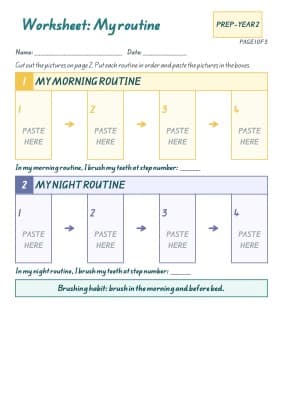
Worksheet: My routine
Students sequence and illustrate their morning and night routine, including brushing, and start a two-week brushing chart to take home.
Conclusion
Review the key message: good daily hygiene — washing our face, cleaning our hands, brushing twice a day, and cleaning between our teeth — keeps germs down and helps protect our teeth.
Students commit to one hygiene goal for the week and take home their brushing chart.