Before the visit55 to 60 minutesPlay & LearnDiscover
Overview
Runs before the visit. Year 5 and 6 students are at the end of the mixed dentition: the second molars are arriving or about to, and the mouth they finish primary school with is close to the mouth they will have at forty. The lesson makes that concrete with the eruption ages and a count, then opens the distinction the rest of the unit runs on, that teeth are damaged in two different ways.
Learning intention
In this lesson, we will work out how much of our adult set is already in, and find out that teeth are damaged in two different ways.
Success criteria
I will know I am successful when I can:
I can use the eruption ages to work out how many of my 32 adult teeth are already in place.
I can explain the difference between decay and erosion in one sentence each.
I can explain why a newly arrived molar needs the most care.
I can complete a 32-tooth chart and write a paragraph on what would have to be true for these teeth to last another seventy years.
Guiding questions
Two teeth are worn away. One had bacteria involved and one did not. Does it matter which?
How many of your adult teeth are already in, and how would you check?
What would actually have to be true for a tooth to last another seventy years?
Vocabulary
permanent dentition — the full adult set of teeth
erupt — when a tooth comes through the gum
decay — damage caused by bacteria making acid from sugar
erosion — damage caused by acid you ate or drank, with no bacteria involved
fissure — a deep narrow groove on the chewing surface of a back tooth
prevalence — how common something is in a group of people
Lesson plan
55 to 60 minutes.
0–4
Intention and the four criteria. Name criterion 4 as the assessed one.
4–10
Guiding question: two worn teeth, one with bacteria involved and one without. Does it matter which? Positions taken and recorded before any teaching.
10–22
Explicit teaching: the eruption table, 20 to 32, why a new molar is the vulnerable one, decay against erosion.
22–36
Count your own. Using the eruption ages, each student works out how many of their 32 are likely in, then checks against their own mouth. Pairs compare and account for differences.
36–42
Game: where-are-my-teeth (existing), as a fast position warm-up before the chart.
42–55
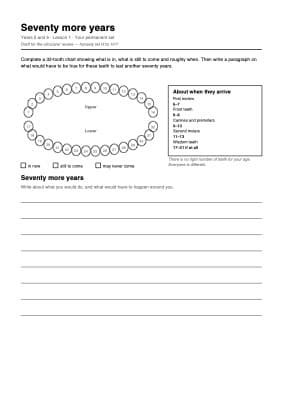
Worksheet: Seventy more years.
55–60
Exit ticket, then the criteria self-check.
Differentiation
Support
Give the eruption table already sorted by age and the chart pre-drawn with the four second molars marked. Paragraph replaced by three sentence stems.
Challenge
Calculate the class mean number of adult teeth in place, compare it with what the eruption table predicts for the cohort's age, and account for the difference.
EAL/D
Pre-teach five of the six terms with images; leave prevalence for the slide where it is used and define it in the same sentence.
Provide the paragraph as a scaffold with four connective prompts. Allow the chart to be labelled in the home language and then in English.
Disability
Chart at A3 with thicker outlines.
The tooth count can be done from a diagram rather than in the mouth; nothing goes in any child's mouth. The paragraph may be recorded as audio.
Inclusion notes
Read before the lesson runs. These are conditions, not preferences.
No student's tooth count is collected by name or displayed.
Orthodontic treatment, missing teeth and teeth already restored are all common in this cohort; say once that a chart with fewer teeth, or with a brace on it, is a normal chart.
Braces are normalised, never aspirational, and never connected to appearance.
Resources
Years 3 – 6 Supporting Resource Pack
Printed Seventy more years sheet with the 32-tooth chart and the eruption table, A4 and A3
The eruption table as a separate large-print card for the support version
Hand mirrors, optional; the count can be done from a diagram
Audio recording device or app, so the paragraph can be spoken
That acid alone wears enamel away with no germs involved, which is why a sugar-free soft drink is still hard on teeth, and the advice to wait about half an hour after something acidic before brushing.
That an orthodontic assessment is recommended between about seven and ten, and that an assessment is not treatment, so braces can be talked about as ordinary rather than as something gone wrong. Most of the page sits inside expandable sections.
Richard J M Lynch, International Dental Journal, December 2013, read on PubMed · Opened 5 September 2026
That both sets of teeth are in the mouth together until about twelve, that baby teeth guide the adult ones into place, and that new enamel keeps hardening after a tooth arrives. The publisher's own page refuses automated clients, so this is the PubMed record for the same article.
Australian Institute of Health and Welfare · Opened 5 September 2026
The two national proportions the Years 5-6 band puts beside the Queensland row, so students can see a survey year as well as a number: children aged 5 to 10 with decay in their baby teeth, and children aged 6 to 14 with decay in their adult teeth.
The figures on the slides
Every figure this lesson puts on a screen, and where it came from. The presenter names each one at the foot of the slide that shows it.
Queensland Child Oral Health Study 2021–24, 7,718 students aged 5 to 14, reported by the University of Queensland, 15 October 2025.
Australian Institute of Health and Welfare, Oral health and dental care in Australia, from the National Child Oral Health Study 2012–14.
Better Health Channel, Teeth development in children, reviewed by the Australian Dental Association Victorian Branch and the Department of Health, 16 August 2023.
Content
Introduction
Put the guiding question up before any teaching: two teeth are worn away, one had bacteria involved and one did not — does it matter which? Record positions; the answer arrives in lessons 3 and 4, not today.
Name criterion 4 as the assessed one, and say that it is a diagnostic rather than a test.
Body
The last of the change
Premolars replace the baby molars at about 9 to 13, second molars arrive at the very back at about 11 to 13, and wisdom teeth at 17 to 21 if at all.
Say 'around', never 'should have by'. A student whose mouth is ahead of or behind the table is not doing anything wrong, and saying so out loud matters at an age when children compare.
20 became 32
You had 20 baby teeth and you will have 32 adult teeth. Apart from wisdom teeth, this is the set you keep.
Give the eruption ages and let students work out their own number rather than telling them one. The arithmetic is the lesson and the variation is real.
The newest teeth are the most vulnerable
Enamel keeps taking up mineral after a tooth arrives, so it becomes harder and less porous with post-eruptive age, and susceptibility to acid falls as that happens.
A twelve-year molar is at its most vulnerable in the year it appears, and its chewing surface carries fissures that are very thin and deep. Never say weak or unfinished: they work, they are less mineralised.
Two ways to lose enamel
Decay needs bacteria: they feed on sugar and make acid on the tooth surface, and mineral leaves the enamel.
Erosion needs no bacteria at all, because the acid arrives already made, in the drink. Do not resolve it further today.
Worksheet: Seventy more years
Complete the 32-tooth chart, then write a paragraph on what would have to be true for these teeth to last another seventy years. Do not mark the paragraph right or wrong.
Conclusion
Most of the set is already in, there is no replacement set, and two different things damage it.
Read the paragraphs for what students already believe causes tooth damage, and carry those beliefs into lessons 3 and 4.
Next lesson the Oral Health Home team are here, and you will interview them.
Which teeth arrive at the very back at about twelve, and what makes them the easiest place to get a cavity?
Application
A drink has no sugar in it at all. Can it still damage a tooth? Say why or why not.
Assessment
Assessment for learning
The paragraph is a diagnostic that shows what each student already believes, which lessons 3 and 4 then confirm or correct. Return it at the end of the unit beside the campaign piece.
Rubric for Your permanent set
Criterion
Working towards
At standard
Above
Explains why the adult set needs different care from the baby set.
states that adult teeth do not grow back
states that, and explains that a newly arrived molar is less mineralised and has grooves a brush cannot reach
does that and uses the eruption ages to say which of their own teeth are most at risk this year
Curriculum links
AC9HP6P10Year 5 and 6
analyse how behaviours influence the health, safety, relationships and wellbeing of individuals and communities
ACARA does not endorse any product that uses the Australian Curriculum or make any representations as to the quality of such products. Any product that uses material published on this website should not be taken to be affiliated with ACARA or have the sponsorship or approval of ACARA.
Cross-curricular
Content descriptions from other learning areas, taught alongside this lesson rather than claimed as its alignment.
AC9M5N04MathematicsOptional
recognise that 100% represents the complete whole and use percentages to describe, represent and compare relative size; connect familiar percentages to their decimal and fraction equivalents
ACARA does not endorse any product that uses the Australian Curriculum or make any representations as to the quality of such products. Any product that uses material published on this website should not be taken to be affiliated with ACARA or have the sponsorship or approval of ACARA.