Content
Introduction
- Ask the guiding question: what can a therapist see in your mouth that you cannot? Take positions and steer towards the surfaces you cannot see and the changes too small to feel.
- Give the vocabulary first — preventive, risk, fissure, sealant, varnish — because a therapist's answer only lands if the words in it are already known.
Body
Preventive means before, not after
- Prevention happens before anything hurts. Some prevention is for everyone and some is only for people at higher risk.
- This distinction is the lesson's spine and it makes the two treatments make sense.
The remineralising varnish
- Painted on at a check-up to help put minerals back into the outside of a tooth. At the Whole Bite Club visit it goes on every child whose family said yes, and consent is settled before the day. It is the preventive step that is for everyone, which is what the spine slide's first half looks like in practice.
- A tooth that already has decay may need a second treatment, one that stops early decay getting worse and that can leave the spot dark. Describe it by what it does, to a family and never to the class: no child's teeth are compared in front of the others.
- Never use the other word for it, in this deck or any other.
The fissure sealant
- A coating painted into the grooves of a newly erupted back molar, because those grooves are very thin and deep and food and bacteria sit in them. Using the tooth wears the sealant down over time, so it is checked, and not every child needs one.
- Say explicitly that the visit checks for sealants and does not place them, and that a family can ask their own dentist.
A question and a follow-up
- A prepared question gets a prepared answer; a follow-up gets a specific one. Model the move once, live, with a student: ask something, listen for a general answer, then ask 'how do you know that?' or 'what would make you decide differently?'
- The second question must come from the first answer and cannot be written in advance.
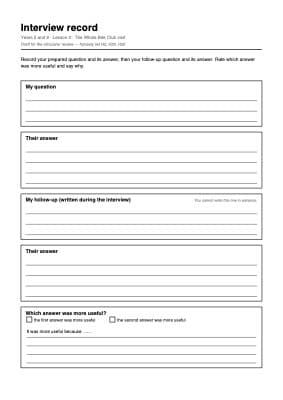
Worksheet: Interview record
- Both questions and both answers, then the judgement: which answer was more useful, and why. The judgement is the assessed part.
Conclusion
- Prevention is targeted, not universal; a good question gets a specific answer; you can always ask how someone knows.
- Ask what you found out that you could not have looked up.
- If your class has no visit booked, the other branch runs the check-up step by step and the interview runs against lesson 5's source cards instead.