Development site. The forms are real and what you enter is saved. No clinic is using it yet.

The Whole Bite Club
All Year 5 and Year 6 lessons

Lesson 3

Demineralise, remineralise

After the visit55 to 60 minutesDiscover

Overview

The science lesson. Enamel is in constant exchange with the mouth around it: acid pulls minerals out, saliva and toothpaste put them back. That turns tooth decay from a moral story into a chemical balance, and it maps exactly onto the Year 6 science content description about reversible and irreversible change. Students run a fair test on eggshell, and then are told honestly what the eggshell cannot show them.

Learning intention

In this lesson, we will find out that enamel loses and regains minerals every day, and work out where the point of no return is.

Success criteria

I will know I am successful when I can:

  • I can explain demineralisation and remineralisation as two directions of the same exchange.
  • I can plan a fair test, naming the variable changed, the variable measured and two variables held the same.
  • I can classify a change as reversible or irreversible and justify it.
  • I can write the plan and the classification on the eggshell test sheet, including one thing the test cannot show us.

Guiding questions

  • If acid takes minerals out every time you eat, why does anyone still have teeth?
  • Which changes in the world can go backwards, and which cannot?
  • The eggshell dissolved overnight. Why does a tooth in a real mouth not?

Vocabulary

  • demineralisation minerals leaving the enamel
  • remineralisation minerals going back into the enamel
  • buffer something that cancels out acid
  • cavitation the point at which a softened surface becomes a hole
  • reversible a change that can go back
  • variable something in an investigation that can change

Lesson plan

55 to 60 minutes.

0–4
Intention and the four criteria.
4–10
Guiding question: if acid takes minerals out every time you eat, why does anyone still have teeth? Predictions recorded.
10–22
Explicit teaching: the exchange, both directions, the point of no return, and what the toothpaste ingredient does.
22–34
The eggshell test. Groups write the plan, name the variables, and set the jars up. Pre-soaked samples are available so an observation exists in this lesson. Label the jar correctly, out loud, as a class.
34–42
Game: Can It Come Back?, then the class debrief on why the eggshell is not a tooth.
42–55
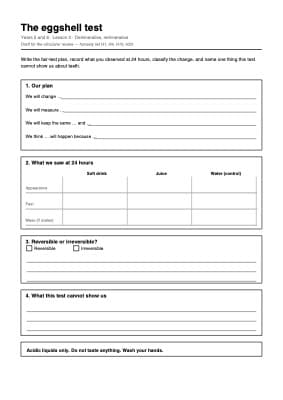
Worksheet: The eggshell test.
55–60
Exit ticket, then the criteria self-check.

Differentiation

Support

  • Supply the plan with the variables listed and the student's job reduced to choosing which to change. Supply pre-soaked samples so the observation exists within the lesson. Sentence stems for block 4.

Challenge

  • Extend to a third condition, an acidic drink followed by milk, and predict the result from the balance model before running it. Then explain why the prediction is about buffering rather than about washing.

EAL/D

  • The four plan slots are printed as sentence frames, which is what they already are.
  • Pre-teach demineralisation and remineralisation as one pair with a two-arrow diagram; the prefix and the suffix do the work. Allow the observation to be drawn.

Disability

  • Nothing goes in any child's mouth and nothing is tasted. Groups can be assigned roles so a student who cannot handle liquids records instead.
  • Reduced-motion users get the game's static reveal.
  • If the school will not run the practical at all, the lesson runs from a demonstration video and every block of the sheet still works.

Inclusion notes

Read before the lesson runs. These are conditions, not preferences.

  • The safety note is on the sheet, not only in the teacher guide, because AC9S5I02 asks students to describe risks themselves.
  • No student's own drinks are used as samples.

Resources

  • Years 3 – 6 Supporting Resource Pack
  • Printed The eggshell test sheet, four blocks, one per student
  • Per group: three clean jars with lids, eggshell pieces from a common source, an acidic soft drink, an acidic juice, and water as the control
  • Pre-soaked eggshell samples prepared 24 hours ahead, so an observation exists inside the lesson
  • Scales, if available, for the mass column
  • Gloves and paper towel; a printed safety note on the sheet itself, per AC9S5I02
  • A demonstration video as the fallback for a school that will not run the practical

Where this comes from

  1. Dental erosion(opens in a new tab)

    Better Health Channel · Opened 5 September 2026

    That acid alone wears enamel away with no germs involved, which is why a sugar-free soft drink is still hard on teeth, and the advice to wait about half an hour after something acidic before brushing.

  2. Fluoride toothpastes of different concentrations for preventing dental caries(opens in a new tab)

    Cochrane Database of Systematic Reviews · Opened 5 September 2026

    That the strengthening ingredient in toothpaste is what prevents decay, and that how much of it there is changes how well it works.

  3. Understanding the chemistry of dental erosion(opens in a new tab)

    John D B Featherstone and Adrian Lussi, Monographs in Oral Science, 2006, read on PubMed · Opened 5 September 2026

    The one chemistry claim the eggshell lesson makes about enamel: that tooth mineral is a calcium-deficient carbonated hydroxyapatite, and that the carbonate in it is what makes tooth mineral dissolve in acid more readily than hydroxyapatite would. The publisher's own page refuses automated clients, so this is the PubMed record for the same article.

  4. Get Sugar Savvy: Sugar and its effect on teeth(PDF, opens in a new tab)

    Australian Dental Association · Opened 5 September 2026 · PDF

    The acid attack itself, step by step: germs feed on sugar, make acid, and the acid softens enamel. It is the mechanism both bands are built on. The file is the association's own factsheet, ADA-branded and carrying its copyright line, but the copy is hosted on DPV Health's server rather than the association's; the repair half of the cycle is Better Health Channel's, cited beside this wherever a lesson teaches it.

Content

Introduction

  • Ask the guiding question: if acid takes minerals out every time you eat, why does anyone still have teeth? Record predictions before any teaching; most classes will not name saliva.
  • Name criterion 4 as the assessed one, and say it is the hardest of the four.

Body

Enamel is not sealed

  • Minerals leave enamel and return to it all day, and which direction wins over months decides whether a cavity forms.
  • A cavity is demineralisation repeatedly outrunning remineralisation. It is not a single event and it is not a punishment.

Out: acid, in: saliva and toothpaste

  • Acid pushes minerals out, either from bacteria fed on sugar or straight from an acidic drink.
  • Saliva pushes them back, by neutralising acid and carrying calcium and phosphate to the surface, and the ingredient in standard toothpaste helps the same repair. The ingredient does the preventing, not the friction.

The point of no return

  • Early damage is reversible: a surface that has softened can take minerals back and re-harden. Once the surface has broken through, it cannot.
  • That wording is the clinicians' own, confirmed on 7 September 2026: asked whether to say reversible or something else, they answered "Reversible." It is no longer a placeholder, and it is still not to be sharpened: the threshold is the claim, and "can re-harden" is doing exact work that "heals" would not.

The fair test

  • Groups write the plan, name the variable changed, the variable measured and two held the same, and set the jars up. Pre-soaked samples make an observation available inside the lesson.
  • Label the jar 'acid dissolving a calcium mineral', out loud, as a class. Never 'tooth decay'.

Why the eggshell is not a tooth

  • Enamel is a calcium-deficient carbonated hydroxyapatite, and the carbonate in it is what makes tooth mineral dissolve in acid more readily than hydroxyapatite would.
  • The eggshell in the jar is a different calcium mineral, which is what the label says and what the practical shows.
  • There is no saliva in the jar, nothing putting minerals back, and no gaps between exposures. Recognising what an investigation cannot show is a science skill, not an apology.

Worksheet: The eggshell test

  • Four blocks. Block 4, what this test cannot show us, is the block that carries the marks.

Conclusion

  • Minerals move both ways, all day. Early damage repairs; a hole does not.
  • After something acidic, rinse with water and wait about half an hour before brushing — say it as advice from Better Health Channel, not as a proven number.
  • Return to the predictions from the start of the lesson and see which of them named saliva.
Worksheets

Exit ticket

  1. Recall

    Name one thing that puts minerals back into enamel.

  2. Application

    Sam drinks a can of soft drink and brushes straight away because he wants to protect his teeth. What would you tell him, and why?

Assessment

Assessment of learning

The classification in block 3 is marked against AC9S6U04 (verified). The fair-test plan in block 1 is marked against this lesson's rubric line, and AC9S5I02 is named as its intended Science alignment awaiting confirmation, not marked against.

Rubric for Demineralise, remineralise
CriterionWorking towardsAt standardAbove
Plans a fair test and judges what it can show.names what will change and what will be measurednames the changed variable, the measured variable and two held the same, and classifies the change correctlydoes that and names a specific reason the test cannot stand for what happens in a mouth

Curriculum links

  • AC9HP6P10Year 5 and 6

    analyse how behaviours influence the health, safety, relationships and wellbeing of individuals and communities

© Australian Curriculum, Assessment and Reporting Authority (ACARA) 2010 to present, unless otherwise indicated. This material was downloaded from the Australian Curriculum website (accessed 5 September 2026) and was not modified. The material is licensed under CC BY 4.0 Attribution 4.0 International Deed.

ACARA does not endorse any product that uses the Australian Curriculum or make any representations as to the quality of such products. Any product that uses material published on this website should not be taken to be affiliated with ACARA or have the sponsorship or approval of ACARA.

Cross-curricular

Content descriptions from other learning areas, taught alongside this lesson rather than claimed as its alignment.

  • AC9S6U04Science

    compare reversible changes, including dissolving and changes of state, and irreversible changes, including cooking and rusting that produce new substances

  • AC9S5I02ScienceDescription awaiting confirmation

    Single-sourced, so it is not counted in any alignment claim and no student work is marked against it.

© Australian Curriculum, Assessment and Reporting Authority (ACARA) 2010 to present, unless otherwise indicated. This material was downloaded from the Australian Curriculum website (accessed 5 September 2026) and was not modified. The material is licensed under CC BY 4.0 Attribution 4.0 International Deed.

ACARA does not endorse any product that uses the Australian Curriculum or make any representations as to the quality of such products. Any product that uses material published on this website should not be taken to be affiliated with ACARA or have the sponsorship or approval of ACARA.