Students meet the number that decides whether a drink softens enamel, then meet a real Australian data set of 177 drinks. The finding that lands hardest is that removing the sugar does not remove the acid: a zero-sugar cola sits in the same erosive band as the full-sugar one. Students handle, compare and represent the data, which is Year 6 statistics as much as it is health.
Learning intention
In this lesson, we will find out what pH 5.5 means for a tooth, and test the idea that sugar-free means tooth-friendly.
Success criteria
I will know I am successful when I can:
I can explain what happens to enamel below about pH 5.5.
I can compare two sets of drink pH values and describe them using range and mode.
I can evaluate the claim "sugar-free is better for your teeth" and say which part of it is true.
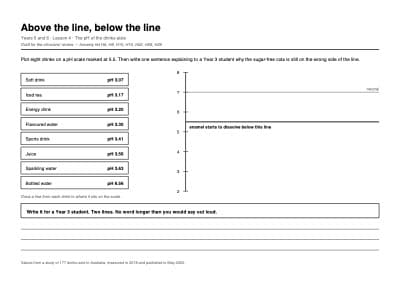
I can plot eight drinks on a pH scale and write one sentence explaining the sugar-free result to a Year 3 student.
Guiding questions
Two colas. One has 16 teaspoons of sugar and one has none. Which is worse for your enamel?
Is a sports drink a drink, or a piece of equipment?
If almost nothing on the shelf is above the line, what is the line actually telling you?
Vocabulary
pH — a number that says how acidic something is; lower means more acidic
critical pH — about 5.5, below which enamel starts to dissolve
erosive — able to dissolve the surface of a tooth
range — the gap between the highest and lowest value
mode — the value that appears most often
sample — the things that were actually measured
Lesson plan
55 to 60 minutes.
0–4
Intention and the four criteria.
4–10
Guiding question: two colas, one with 16 teaspoons of sugar and one with none. Which is worse for enamel? Positions taken and recorded.
10–20
Explicit teaching: pH as a measurement, the line at about 5.5, what the study did.
20–30
Game: Below 5.5, predict before every reveal.
30–42
Rank and measure. Groups predict the order of five drinks, then measure with strips or a probe, then compare with the published category means. Account for any difference; the paper itself notes temperature affects the reading.
42–55
Worksheet: Above the line, below the line.
55–60
Exit ticket, then the criteria self-check.
Differentiation
Support
Give the pH scale as a printed strip with 5.5 already ruled, and have students place drink cards on it rather than read a table. Give the sentence as a two-part frame.
Challenge
Measure three drinks with strips or a probe, compare with the published values and account for the difference. The paper notes drinks tested warmer read lower, which is a real and satisfying explanation.
EAL/D
pH is a symbol before it is a word; introduce it as a number on a scale with no etymology.
The "wrong side of the line" is idiomatic and gets replaced on the sheet with "below the line". Sentence frames for the Year 3 explanation.
Disability
The scale is available at A3 and as a large-print version with the eight values pre-plotted for students to label rather than draw.
Strips are read in pairs so no student is required to make a fine colour judgement alone, and any colour matching has a printed number scale beside it.
Inclusion notes
Read before the lesson runs. These are conditions, not preferences.
No student's own drink bottle is measured, displayed or discussed.
Say once that this lesson is about what is in a drink and never about who drinks it.
Do not connect any drink to weight, body size or appearance; the sugar and obesity link is real and is not this unit's subject.
Resources
Years 3 – 6 Supporting Resource Pack
Printed Above the line, below the line sheet, A4 landscape, plus an A3 large-print version with the eight values pre-plotted for labelling
pH strips or a pH probe, one set per group; strips read in pairs so no student makes a fine colour judgement alone, with a printed number scale beside any colour chart
Five drinks for the measuring task, poured into unlabelled cups by the teacher; no student's own bottle is used
The printed pH scale strip with 5.5 already ruled, for the support version
The data-source attribution card for Schmidt and Huang
That acid alone wears enamel away with no germs involved, which is why a sugar-free soft drink is still hard on teeth, and the advice to wait about half an hour after something acidic before brushing.
Why the lessons say tap water helps protect teeth in many places rather than everywhere: about 72 per cent of Queenslanders have a treated supply, and most councils have stopped treating.
Jeremiah Schmidt and Boyen Huang, International Journal of Scientific Study, volume 8 issue 2, May 2020 · Opened 5 September 2026 · PDF
The acidity readings behind the drinks data set. The paper's Materials and Methods section is where the method sits: 177 drinks sold in Australia, each measured three times at 22 °C, with dairy drinks left out. The journal lists it as item 8 of the May 2020 issue.
Two things. How long enamel stays soft after acid — the page puts it at 20 to 30 minutes, and the class is taught the 20 the clinicians ruled on. And which drinks are acidic enough to wear enamel away, sugar-free soft drinks among them, with the food acids a student reads off a label listed in its own sentence further up the same page: "foods with additives — such as citric acid, sodium citrate or phosphoric acid". It is the national service saying independently what the acidity paper measured.
The figures on the slides
Every figure this lesson puts on a screen, and where it came from. The presenter names each one at the foot of the slide that shows it.
Sugar figures from Rethink your drink, Rethink Sugary Drink, a partnership of Cancer Council Victoria, Diabetes Victoria and the Heart Foundation. Poster artwork dated 22 August 2016. Please note these are estimates only, different flavoured drinks may vary. Always look at your nutrition labels for more accurate information.
pH values from Schmidt J and Huang B, 'The Acidity of Non-alcoholic Beverages in Australia: Risk of Dental Erosion', International Journal of Scientific Study, May 2020, volume 8 issue 2. 177 beverages sold in Australia, each measured three times at 22 °C. Dairy drinks were not included.
Content
Introduction
Ask the guiding question: two colas, one with 16 teaspoons of sugar and one with none — which is worse for your enamel? Take positions and record the split. Most classes vote for the sugary one.
Say that today's answer comes from a table of measurements, not from an opinion.
Body
pH is a measurement
A number that says how acidic something is, lower meaning more acidic, with 7 in the middle. Stop there: no ions, no logarithms, no acid-base theory.
The Australian Dental Association's own classroom material puts acid-base chemistry at Years 9–10; this band takes the measurement without the theory.
The line at 5.5
At about pH 5.5 enamel begins to dissolve, so a drink below that line can soften a tooth surface directly, with no bacteria involved.
Say 'about', because the exact figure varies with the calcium and phosphate in a person's saliva. Honesty item H6.
What the study did
177 drinks sold in Australia, each measured three times, bought off the shelf rather than made in a lab, measured in 2018 and published in 2020.
Method, sample size and date are all stated, and pointing that out is the bridge into lesson 5. Also say what the table gets wrong: the counts add to 178, and the juice range repeats the sports-drink range.
The pair that settles it
A full-sugar cola measured 2.61 and its no-sugar version 3.12. Both are below the line.
Removing the sugar removes the fuel for decay and does nothing at all about erosion. Go back to the vote here.
Water
No sugar, no acid, and it rinses your mouth, so it is the best drink for your teeth anywhere.
In many Queensland towns the tap water is also treated with a mineral that helps make enamel stronger, and not every town treats its water, so it is worth asking at home. The first part is true everywhere; the second is not, and the split is deliberate.
For you, not for the slide: in South East Queensland the tap water is treated; many regional towns' is not, so ask at home. That is the clinicians' own account, given on 7 September 2026, and it stays attributed to them until somebody opens Queensland Health's water status page and records their name and the date.
Worksheet: Above the line, below the line
Plot eight drinks on a pH scale marked at 5.5, then explain the sugar-free result to a Year 3 student in two lines.
Conclusion
Below 5.5, enamel dissolves. Almost nothing on the shelf is above it, and the eleven drinks that were are all bottled water.
Taking the sugar out does not take the acid out.
Ask what is in your drink bottle tomorrow. Never connect any drink to weight, body size or appearance.
A drink is advertised as having no sugar. Name one thing you would still want to know about it, and say why.
Assessment
Assessment of learning
The explanatory sentence written for a younger reader is the assessable piece, because simplifying without breaking the idea requires holding it firmly.
Rubric for The pH of the drinks aisle
Criterion
Working towards
At standard
Above
Uses evidence to evaluate a health claim.
states that sugar-free drinks can still harm teeth
states that and explains it with both halves, no sugar for the bacteria and acid that dissolves enamel on its own
does that and cites a value from the data set to support it
Curriculum links
AC9HP6P09Year 5 and 6
investigate different sources and types of health information and how these apply to their own and others' health choices
ACARA does not endorse any product that uses the Australian Curriculum or make any representations as to the quality of such products. Any product that uses material published on this website should not be taken to be affiliated with ACARA or have the sponsorship or approval of ACARA.
Cross-curricular
Content descriptions from other learning areas, taught alongside this lesson rather than claimed as its alignment.
AC9M6ST01Mathematics
interpret and compare data sets for ordinal and nominal categorical, discrete and continuous numerical variables using comparative displays or visualisations and digital tools; compare distributions in terms of mode, range and shape
ACARA does not endorse any product that uses the Australian Curriculum or make any representations as to the quality of such products. Any product that uses material published on this website should not be taken to be affiliated with ACARA or have the sponsorship or approval of ACARA.