The unit closes where AC9HP6P09 points: at sources. Students compare four things that say different things about the same drink, work out which they can rely on and why, then build a campaign piece for a real audience in their own school. This is the Years 5–6 answer to the F-2 "healthy smile hero" finish, and it carries the band's summative work sample.
Learning intention
In this lesson, we will work out which sources of health information we can rely on, and build a campaign that tells our school something true.
Success criteria
I will know I am successful when I can:
I can rank four sources on the same claim from most to least reliable, and justify the ranking.
I can identify one way a graph or an advertisement can mislead without lying.
I can name who made a health message and what they want the reader to do.
I can produce a campaign piece with an accurate claim, a named source and a specific audience.
Guiding questions
Four things say different things about the same drink. Who do you believe, and why?
How do you mislead someone using only true numbers?
Who decides what counts as a healthy drink?
Vocabulary
source — where a piece of information came from
claim — something someone says is true
verify — check whether something is actually true
sample size — how many things were measured
vested interest — a reason someone gains from you believing them
audience — the particular people a message is for
Lesson plan
55 to 60 minutes.
0–4
Intention and the four criteria.
4–10
Guiding question: four things say different things about the same drink. Who do you believe? Positions recorded.
10–22
Explicit teaching: the four checks, and the three ways of misleading with true numbers. One example of each shown.
22–32
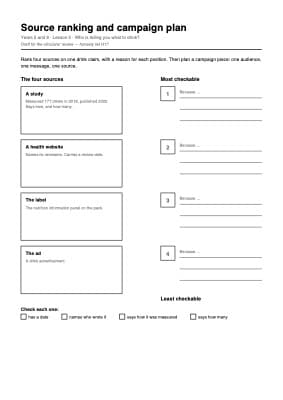
Groups rank the four cards for themselves and argue the two they disagreed on. That argument is the lesson.
32–42
Rehearse the emergency, then recap the mouthguard list. In threes, students run the knocked-out-tooth scene aloud with props and no script: one is hurt, one finds the tooth and handles it correctly, one gets an adult and says what happened in one sentence. Twice through, swapping roles, about six minutes. Then the mouthguard list, as one of the campaign topics.
42–55
Worksheet: Source ranking and campaign plan, then start building the piece.
55–60
Exit ticket, the criteria self-check, and the certificate slide.
Differentiation
Support
Give the four sources pre-extracted onto cards of equal length so the ranking is about the source and not about reading load.
Pre-fill the first row of the ladder as a worked example. The campaign piece may be a poster with three elements rather than a written text.
Challenge
Find a real advertisement or social post making a drink claim, check it against the nutrition information panel and one health source, and write the correction.
Or take the energy drinks motion, "Should energy drinks be sold to people under 16?".
EAL/D
Column headings written as questions. Sentence frames for every reason line.
The campaign piece may be delivered orally or as a recorded 30-second announcement, which is the same evidence as a written one.
Disability
Every written outcome has a spoken or drawn alternative, and this is the lesson where that matters most because the product is the assessment. Recording counts.
Drag interactions in the game have a select-then-place keyboard path with 64 px targets.
Inclusion notes
Read before the lesson runs. These are conditions, not preferences.
No comparative decay statistics by group appear in any student-facing material; the Queensland figures used are whole-population.
If access comes up, discuss it as access, which is accurate and is not blaming: distance to a clinic, cost, and which towns treat their water.
Anything culturally specific about First Nations oral health is developed with and attributed to an Aboriginal health organisation and is not written in-house; this is an input required from Oral Health Home, client question C10.
Resources
Years 3 – 6 Supporting Resource Pack
The four source cards, pre-extracted onto cards of equal length so the ranking is about the source and not about reading load
Printed Source ranking and campaign plan sheet, A4 double-sided
One example each of a broken-axis graph, an out-of-scale graphic and a claim about a different population
Props for the rehearsal: a model tooth, a cup, a cloth — the same set as Years 3–4 lesson 5
Poster card, or a recording device for the spoken version of the campaign piece
A booked follow-up session of 30 to 40 minutes for building the campaign piece
The first aid for a knocked-out adult tooth: hold it by the top, put it back if you can, keep it in milk if you cannot, and never put a baby tooth back.
Australian Dental Association · Opened 5 September 2026
What to do with a knocked-out adult tooth, in the order the page gives it: if it is dirty, one gentle rinse and never a scrub; back in the socket straight away; and, where it cannot go back, it travels in milk or the person’s own spit, never in water, in the page’s own words "Put the tooth in milk or your child's saliva to transport it to the dentist as soon as possible".
The University of Queensland · Opened 5 September 2026
The Queensland figures the lessons use: decay in the baby teeth of children aged 5 to 10 fell from 49.5 per cent to 38.8 per cent between the two surveys.
Jeremiah Schmidt and Boyen Huang, International Journal of Scientific Study, volume 8 issue 2, May 2020 · Opened 5 September 2026 · PDF
The acidity readings behind the drinks data set. The paper's Materials and Methods section is where the method sits: 177 drinks sold in Australia, each measured three times at 22 °C, with dairy drinks left out. The journal lists it as item 8 of the May 2020 issue.
Australian Institute of Health and Welfare · Opened 5 September 2026
The two national proportions the Years 5-6 band puts beside the Queensland row, so students can see a survey year as well as a number: children aged 5 to 10 with decay in their baby teeth, and children aged 6 to 14 with decay in their adult teeth.
Fouad AF and others, Dental Traumatology, 2020, read from a Wayback snapshot · Opened 5 September 2026
The timing behind the first aid, for the teacher note rather than the slide: how long a knocked-out adult tooth can be out of the mouth, and why milk or the person's own spit buys time that a dry pocket does not.
The figures on the slides
Every figure this lesson puts on a screen, and where it came from. The presenter names each one at the foot of the slide that shows it.
Queensland Child Oral Health Study 2021–24, 7,718 students aged 5 to 14, reported by the University of Queensland, 15 October 2025.
Adapted from Australian Dental Association advice on dental trauma, and from Better Health Channel, Dental injuries.
Content
Introduction
Ask the guiding question: four things say different things about the same drink — who do you believe, and why? Take positions before the checks are taught, and do not rank the sources for the class.
Name criterion 4 as the summative work sample for the whole band.
Body
Four things about one drink
The manufacturer's own front-of-pack claim, an advertisement for it, a government health page, and a peer-reviewed study.
Same claim, four sources. The ranking is the lesson and it has to be earned.
What makes a source checkable
Four checks: does it carry a date, does it name who wrote it, does it say how it was measured, and does it say how many things were measured.
The drinks study from lesson 4 is the worked example, and it is a good source not because it agrees with us but because it states its method, its sample of 177 and its year.
Misleading with true numbers
A graph with a broken axis, a graphic not drawn to scale, and data about a population other than the one the claim is about.
Show one example of each. Students who can name these are doing Year 6 statistics and health literacy in the same move.
Rehearse the emergency
In threes, no script, with props: one is hurt, one finds the tooth and holds it by the crown, one gets an adult and says what happened in one sentence. Twice through, swapping roles.
The dirty tooth is rehearsed too, because it is the step a child will actually meet: a quick rinse in milk or their own spit, never a scrub, then back in straight away rather than after a think. Never water is unchanged.
Then the campaign menu, including mouthguards and the knocked-out tooth plan, which Years 3–4 teaches in full and this band does not leave without.
The campaign
One message, one audience, one named source. The audience must be specific and real: a Year 3 class, the canteen committee, families at assembly, the school newsletter.
The plan and a rough draft are made in this lesson; the finished piece is built in a follow-up session of 30 to 40 minutes in the same week.
Worksheet: Source ranking and campaign plan
The ranking is on side one and the plan on side two.
Conclusion
Check the date, the method and who paid. One message, one audience, one source. Water is still the best drink.
The campaign says what something does in the mouth. It never says a food is bad, and it says nothing at all about weight, size or bodies.
Hand back the lesson 1 paragraphs beside the campaign piece so students can see the distance travelled. Certificate.
Name two of the four things that make a source checkable.
Application
A drink advertisement shows a bar chart where the bars start at 40 instead of 0. What does that do, and why would someone do it?
Assessment
Assessment of learning
The campaign piece is the band's summative work sample against AC9HP6P09, made across two sittings: the plan and a rough draft in this lesson, the finished piece in a follow-up session of 30 to 40 minutes in the same week. A school that cannot find the follow-up session marks side two of the worksheet against the same four rows.
Rubric for Who is telling you what to drink?
Criterion
Working towards
At standard
Above
The claim is accurate
Makes a health claim related to the unit
Makes a claim that matches what the unit taught, with no overstatement
Makes an accurate claim and states its limit, such as the year it was measured
The source is named and real
Mentions a source
Names a source specifically enough for someone else to find it
Names it and says why it is checkable
The audience is specific
Names a general audience such as "the school"
Names a particular group and shows the message is shaped for them
Does that and says where and when they will see it
Investigates and reports evidence
Records what was observed or measured
Names the variable changed, the variable measured and two held the same, and reports the result accurately
Does that and says what the investigation or the data set cannot show
Curriculum links
AC9HP6P09Year 5 and 6
investigate different sources and types of health information and how these apply to their own and others' health choices
AC9HP6P08Year 5 and 6
analyse and rehearse protective behaviours and help-seeking strategies that can be used in a range of online and offline situations
ACARA does not endorse any product that uses the Australian Curriculum or make any representations as to the quality of such products. Any product that uses material published on this website should not be taken to be affiliated with ACARA or have the sponsorship or approval of ACARA.
Cross-curricular
Content descriptions from other learning areas, taught alongside this lesson rather than claimed as its alignment.
ACARA does not endorse any product that uses the Australian Curriculum or make any representations as to the quality of such products. Any product that uses material published on this website should not be taken to be affiliated with ACARA or have the sponsorship or approval of ACARA.