
Development site. The forms are real and what you enter is saved. No clinic is using it yet.

The Whole Bite Club
All Year 3 and Year 4 lessons

Lesson 2

The Whole Bite Club visit

The visit45 to 50 minutesDiscoverPracticeReceive

Overview

The visit is the centrepiece and the classroom lessons are built around it. Students take part in one coordinated session with the Oral Health Home team: a whole-class lesson, then small groups of four to six for brushing and between-teeth practice and an individual check. At Years 3–4 students are old enough to prepare a question in advance and record the answer, so this lesson gives them a job to do rather than only an experience to have. The deck forks, because a school with no visit booked still runs the lesson.

Learning intention

In this lesson, we will meet an oral health team, find out what a check-up looks for, and get our own questions answered.

Success criteria

I will know I am successful when I can:

  • I can name three things an oral health therapist looks for in a check-up.
  • I can ask the question I prepared.
  • I can write down the answer in my own words.

Guiding questions

  • What is someone actually looking for when they look in your mouth?
  • What would you ask a person who looks in mouths all day?
  • Why do we practise brushing instead of just being told about it?

Vocabulary

  • oral health therapist a person trained to check and clean teeth
  • check-up a look at your teeth to find small problems early
  • plaque the soft film of germs on teeth
  • remineralising varnish a coating painted on to help put minerals back into a tooth
  • sealant a thin coating painted into the grooves of a back tooth

Lesson plan

45 to 50 minutes.

0–3
Intention and the three criteria.
3–8
Hook: "What is someone actually looking for when they look in your mouth?" onto the chart.
8–16
Explicit teaching: who is coming, what a check-up looks for, the varnish and the sealant.
16–24
Write your question. Three stems on the board, thirty seconds to choose, then write. Everyone reads theirs to a partner.
24–30
Game: check-up-order (existing), so the order of the session is known before it starts.
The visit. Whole-class session about 30 minutes, then small groups of four to six, about 15 minutes each.
30–43
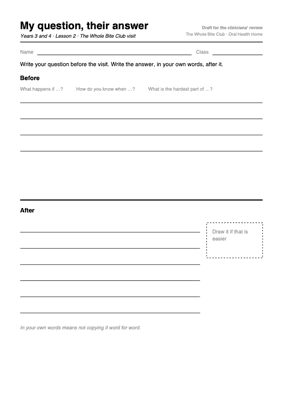
After the visit: worksheet My question, their answer.
43–50
Exit ticket, then the criteria self-check.

Differentiation

Support

  • Pre-teach the five words with pictures the day before. Give the three question stems on a card to keep. Two-column note frame so recording does not depend on writing speed.

Challenge

  • Take the role of class recorder and write the visit up as a short piece for the school newsletter, which feeds straight into lesson 5's message-making.

EAL/D

  • Sentence frames for both halves of the sheet. Allow the question to be drafted in the home language and translated with a partner. The therapist can be asked to speak slowly on request, arranged before the day.

Disability

  • The written answer may be spoken, recorded or drawn. A student who does not want to be looked at individually is never singled out; the small-group session is arranged with the teacher in advance, and the classroom half of the lesson stands alone.

Inclusion notes

Read before the lesson runs. These are conditions, not preferences.

  • A child who discloses dental pain or fear needs the guide's disclosure protocol, which is prepared before this day and not during it: take it seriously, do not attempt treatment, contact the family the same day, and point to public dental services and the Child Dental Benefits Schedule.
  • Cost is never mentioned in front of the class.

Resources

  • Years 3 – 6 Supporting Resource Pack
  • Printed My question, their answer sheet, one per student
  • The three question stems on a card, one per table
  • Class chart or whiteboard
  • The guide's disclosure protocol, read before the day, not on it

Where this comes from

  1. Kids Health Info: Dental care(opens in a new tab)

    The Royal Children’s Hospital Melbourne · Opened 5 September 2026

    That a check-up is a regular habit rather than something you go for when a tooth hurts, and roughly how often children go.

  2. Dental Care For Kids(opens in a new tab)

    Australian Dental Association · Opened 5 September 2026

    That cleaning between teeth starts once two teeth touch, which is why a brush on its own is not the whole job.

  3. Policy Statement 2.2.1 - Fluoride Use(opens in a new tab)

    Australian Dental Association · Opened 5 September 2026

    That professional application of a remineralising varnish is a clinical decision an oral health professional makes, rather than a routine applied to a whole population without one. It is not cited for what the Whole Bite Club visit does — painted on every child whose family said yes — which is the clinicians' own account of their own program and is registered as that.

  4. Fissure sealant(opens in a new tab)

    Australian Dental Association · Opened 5 September 2026

    That the grooves on a new back tooth are very thin and deep and trap food and bacteria, that a sealant closes them, and that not every child or every tooth needs one.

Content

Introduction

  • Ask the guiding question: what is someone actually looking for when they look in your mouth? Take answers onto the chart. Expect 'holes'; widen it to gums, how teeth are growing in, and whether anything hurts.
  • Name the job for today: every student leaves with one question asked and one answer written down.

Body

Who is coming, and what happens

  • Registered oral health therapists, who look in mouths all day. Describe what happens in order and in neutral words: they count your teeth, they take a look with a small mirror, they might paint something on.
  • Never say needle, drill, pain, hurt or pull, and never say 'it won't hurt', because that makes a child think about hurting. Never use the dentist as a threat.

Write your question

  • Give three stems so nobody arrives without one: 'What happens if …', 'How do you know when …', 'What is the hardest part of …'.
  • Thirty seconds to choose a stem, then write. Everyone reads theirs to a partner.

Varnish and sealants, as decisions

  • A remineralising varnish is painted on to help put minerals back into the outside of a tooth, and at the visit it goes on every child whose family said yes. Say that out loud, because a child who has it and a child who does not must both hear that the difference is what a family answered, not what their teeth are like.
  • A sealant is a thin coating painted into the grooves of a back adult molar, because those grooves are very thin and deep, and an oral health professional decides who needs one. Say plainly that the visit checks for sealants but does not place them.
  • A tooth that already has decay may need a second treatment, one that stops early decay getting worse and can leave that spot dark. It is described by what it does, to you and to a family, and never to the class.

Worksheet: My question, their answer

  • The top half is filled in before the visit and the bottom half after it, in the student's own words rather than copied.

Conclusion

  • A check-up finds small problems early, a varnish puts minerals back, and a sealant fills a groove.
  • Ask what surprised you. Take three answers and stop.
  • If your class has no visit booked, the other branch of the deck walks through the same check-up step by step and the lesson stands alone.
Worksheets

Exit ticket

  1. Recall

    Name two things an oral health therapist looks for in a check-up.

  2. Application

    Your friend is worried about going to the dentist next week. What is one true thing you could tell them about what happens?

Assessment

Assessment as learning

The recorded answer shows whether the student can restate rather than copy, which is the beginning of the AC9HP4P09 skill.

Rubric for The Whole Bite Club visit
CriterionWorking towardsAt standardAbove
Records a health message from a person in their own words.records an answer, mostly copiedrecords the answer in their own words so it still makes sensedoes that and adds what they would ask next

Curriculum links

  • AC9HP4P09Year 3 and 4

    interpret the nature and intention of health information and messages, and reflect on how they influence personal decisions and behaviours

  • AC9HP4P10Year 3 and 4

    investigate and apply behaviours that contribute to their own and others' health, safety, relationships and wellbeing

© Australian Curriculum, Assessment and Reporting Authority (ACARA) 2010 to present, unless otherwise indicated. This material was downloaded from the Australian Curriculum website (accessed 5 September 2026) and was not modified. The material is licensed under CC BY 4.0 Attribution 4.0 International Deed.

ACARA does not endorse any product that uses the Australian Curriculum or make any representations as to the quality of such products. Any product that uses material published on this website should not be taken to be affiliated with ACARA or have the sponsorship or approval of ACARA.

Extension

Free with a teacher account

3 extension activities for this lesson, and a link into English.

The lesson itself, its worksheets list, the presenter and every deck stay open to everyone, with no account.

An account also adds three more games, a five-slide deck for you, and three printables.