Development site. The forms are real and what you enter is saved. No clinic is using it yet.

The Whole Bite Club
All Year 3 and Year 4 lessons

Lesson 1

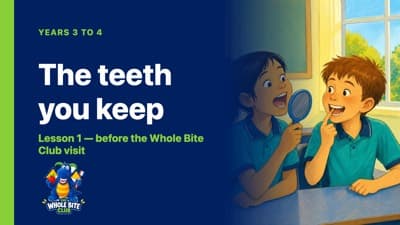
The teeth you keep

Before the visit45 to 50 minutesPlay & LearnDiscover

Overview

This lesson runs before the Whole Bite Club visit. Students find out that the adult teeth arriving in their mouths right now are the last set they will get, that four of them arrived at the back at about six without anything falling out to make room, and that a brand new adult tooth is not yet as tough as it will be. It sets up the visit by giving students something specific to look for in their own mouths.

Learning intention

In this lesson, we will find out which of our teeth are here for life, and what a tooth is made of.

Success criteria

I will know I am successful when I can:

  • I can explain that adult teeth do not grow back, and say why that changes how we look after them.
  • I can find my first adult molars and say when they arrived.
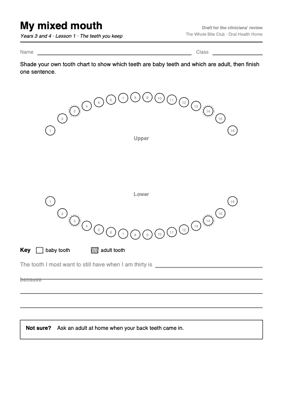
  • I can shade a tooth chart to show which of my teeth are baby teeth and which are adult teeth.

Guiding questions

  • Which of the teeth in your mouth now will still be there when you are thirty?
  • Why are the first adult molars the easiest teeth to miss?
  • What is a tooth actually made of?

Vocabulary

  • permanent tooth an adult tooth, which does not grow back
  • molar a wide tooth at the back that grinds food
  • erupt when a tooth comes through the gum
  • enamel the hard white outside of a tooth
  • dentine the softer layer under the enamel

Lesson plan

45 to 50 minutes.

0–3
Intention and the three criteria. Name criterion 3 as the one collected.
3–8
Hook: "Which of the teeth in your mouth now will still be there when you are thirty?" Record every answer on the class chart without correcting any.
8–18
Explicit teaching from the deck: 20 to 32, the arrival table, the teeth that arrived in secret, inside a tooth.
18–26
Find your own. Tongue to the very back, top and bottom, both sides. Pairs count how many wide back teeth each has and compare with the table. Mirrors for anyone who wants one.
26–33
Game: where-are-my-teeth (existing F-2 game, reused as a position warm-up before the chart).
33–43
Worksheet: My mixed mouth.
43–50
Exit ticket, then the criteria self-check.

Differentiation

Support

  • Give the chart with the first molars already shaded as a worked example on a second small diagram beside it. Offer a mirror and a partner. Accept the sentence spoken and scribed.

Challenge

  • Plot your own eruption timeline against the arrival ages and work out how many years of mixed mouth you have left. Then compare a human molar with a sheep's and a cat's and explain the shapes from what each animal eats.

EAL/D

  • Pre-teach the five words the day before, each with a picture. Give the sentence frame "The tooth I most want to keep is my …………… because ……………". Let students name teeth in their home language first, then in English.

Disability

  • Nothing goes in any child's mouth; the tongue check is optional and can be replaced by pointing at a large diagram. Provide the chart at A3 with thicker outlines for students with fine-motor or vision needs. The shading key uses a pattern, not a colour, so colour is never the only signal.

Inclusion notes

Read before the lesson runs. These are conditions, not preferences.

  • Tooth-loss customs vary and the tooth fairy is not universal; if the loss of baby teeth comes up, ask what happens at your place rather than assuming.
  • No child's number of adult teeth is compared publicly or recorded by name.

Resources

  • Years 3 – 6 Supporting Resource Pack
  • Printed My mixed mouth chart, one per student, A4 and A3
  • Hand mirrors, one per pair, optional
  • Class chart or whiteboard for the hook
  • Large tooth cross-section diagram for the enamel and dentine slide

Where this comes from

  1. Teeth development in children(opens in a new tab)

    Better Health Channel · Opened 5 September 2026

    That children grow two sets of teeth, roughly when each adult tooth arrives, and that baby teeth hold the space the adult teeth need.

  2. Dental erosion(opens in a new tab)

    Better Health Channel · Opened 5 September 2026

    That acid alone wears enamel away with no germs involved, which is why a sugar-free soft drink is still hard on teeth, and the advice to wait about half an hour after something acidic before brushing.

  3. The primary and mixed dentition, post-eruptive enamel maturation and dental caries: a review(opens in a new tab)

    Richard J M Lynch, International Dental Journal, December 2013, read on PubMed · Opened 5 September 2026

    That both sets of teeth are in the mouth together until about twelve, that baby teeth guide the adult ones into place, and that new enamel keeps hardening after a tooth arrives. The publisher's own page refuses automated clients, so this is the PubMed record for the same article.

Content

Introduction

  • Ask the guiding question: which of the teeth in your mouth now will still be there when you are thirty? Record every answer on the class chart and correct none of them yet.
  • Tell the class that today they will find out which of their own teeth are the last set they will get.

Body

Two sets, one lifetime

  • You had 20 baby teeth and you will have 32 adult teeth. There is no third set.
  • Between about six and about thirteen a child carries both sets at once, and every adult tooth that arrives is the last one that will fill that space.

The teeth that arrived in secret

  • The first permanent molars arrive at about six, at the very back, behind the last baby molars. Nothing falls out to make room, so there is no wobble.
  • Have every student find their own with their tongue, top and bottom, both sides. Mirrors for anyone who wants one, and pointing at the diagram is fine for anyone who does not.

Inside a tooth, and why it matters

  • Enamel is the hard white outside, dentine is the softer layer under it, and the middle is alive and can feel. Enamel does not grow back, which is why prevention is the only strategy that works.
  • A brand new adult tooth is not as tough as it will be in a couple of years; enamel keeps taking up minerals for months after it comes through. Say 'not as tough yet', never 'weak' or 'unfinished'.

Worksheet: My mixed mouth

  • Students shade their own chart to show baby and adult teeth, then finish the sentence. Collect these.

Conclusion

  • Go back to the class chart from the hook and check the predictions against what we found.
  • Adult teeth do not grow back, four of them arrived at about six with no wobble, and the newest teeth need the most help.
  • Next lesson the Oral Health Home team are here.
Worksheets

Exit ticket

  1. Recall

    Do adult teeth grow back if they are lost?

  2. Application

    Mia says the wide teeth at the very back of her mouth are baby teeth, because none of them has ever wobbled. What would you tell her?

Assessment

Assessment for learning

The shaded chart is a diagnostic collected in lesson 1 and returned in lesson 5, so students can see what they knew at the start.

Rubric for The teeth you keep
CriterionWorking towardsAt standardAbove
Identifies which of their own teeth are permanent.shades a chart and names at least one adult toothshades the chart with the four first permanent molars correctly marked as adult teethdoes that and explains, using the arrival ages, why nothing wobbled first

Curriculum links

  • AC9HP4P10Year 3 and 4

    investigate and apply behaviours that contribute to their own and others' health, safety, relationships and wellbeing

© Australian Curriculum, Assessment and Reporting Authority (ACARA) 2010 to present, unless otherwise indicated. This material was downloaded from the Australian Curriculum website (accessed 5 September 2026) and was not modified. The material is licensed under CC BY 4.0 Attribution 4.0 International Deed.

ACARA does not endorse any product that uses the Australian Curriculum or make any representations as to the quality of such products. Any product that uses material published on this website should not be taken to be affiliated with ACARA or have the sponsorship or approval of ACARA.