After the visit, students go under the surface of the F-2 story. Germs on a tooth turn sugar into acid, the acid pulls minerals out of the enamel, saliva puts them back, and this happens every single time we eat or drink. From that comes the idea the whole band turns on: how often matters, not only how much. This is the lesson that changes a lunchbox without ever ranking a food.
Learning intention
In this lesson, we will find out what an acid attack is, and why how often we eat matters as much as how much.
Success criteria
I will know I am successful when I can:
I can explain, in order, how sugar becomes acid and acid softens a tooth.
I can say what saliva does between meals.
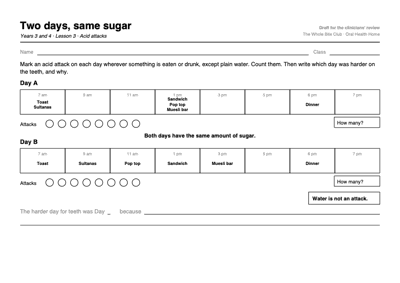
I can mark the acid attacks on two days that have the same amount of sugar, and say which day was harder on the teeth.
Guiding questions
Five lollies at once, or one lolly every hour for five hours. Which is harder on your teeth?
What is your mouth doing between meals?
If acid arrives every time we eat, why does anyone still have teeth?
Vocabulary
plaque — the soft film of germs on teeth
acid — what germs make from sugar, which softens enamel
saliva — spit, which washes acid away and carries minerals back
mineral — the hard stuff enamel is built from
snack — anything eaten between meals
Lesson plan
45 to 50 minutes.
0–3
Intention and the three criteria.
3–8
Hook: five lollies at once, or one an hour for five hours. Every student commits to an answer with a show of hands, recorded on the chart. Nobody is told yet.
8–18
Explicit teaching: plaque, the four steps, saliva, and "every time you eat or drink".
18–33
Game: Sugar Clock, played twice. First run, each student places the six cards anywhere. Second run, place the same six cards to light the fewest markers. Discuss what changed.
33–43
Worksheet: Two days, same sugar.
43–50
Exit ticket, then the criteria self-check.
Differentiation
Support
Give the four steps as pre-cut picture cards to sequence before any writing. Day A's attacks pre-marked as a worked example. Sentence starter: "Day B was harder because ……".
Challenge
Design two whole school days with identical total sugar but different timing, swap with a partner, and argue which mouth is worse off. Add a third day where water follows each sweet thing and predict what changes.
EAL/D
Every step carried by a picture before any word. Pre-teach the five terms with images. Sentence frames on the worksheet and the exit ticket. "Attack" is a metaphor and needs saying plainly once: it means the acid is working on the tooth, nothing is fighting.
Disability
Timelines available at A3 with larger boxes. Ticking circles can be replaced by placing counters. The game has a select-then-place keyboard path and 64 px targets, and nothing animates under `prefers-reduced-motion`.
Inclusion notes
Read before the lesson runs. These are conditions, not preferences.
No child's actual eating is discussed, collected or displayed, and neither timeline belongs to anyone in the room. Both days are a fictional person's.
Say once, out loud, that nothing on the sheet is a food anyone should stop eating. A child who is fasting is not asked to describe their eating times.
Resources
Years 3 – 6 Supporting Resource Pack
Printed Two days, same sugar timeline sheet, A4 landscape and A3
The four-step sequence as pre-cut picture cards, one set per support group
Counters, as an alternative to ticking the attack circles
Class chart or whiteboard for the hook split
Where this comes from
Oral Health Home's answers to the platform's decisions, September 2026
Oral Health Home · Held by Oral Health Home; not published online
Five things only the clinicians can say: that in the schools the club visits about 40 to 45 per cent of children have already had tooth decay and in some it is closer to half; that the acid attack is taught as about 20 minutes, the single figure inside the published range; that at a school visit the remineralising varnish is painted on every child whose family said yes; that thirteen teaspoons of sugar in a bottle is not for children; and, until Queensland Health's own page is opened by a named person, that South East Queensland's tap water is treated and many regional towns' is not.
That acid alone wears enamel away with no germs involved, which is why a sugar-free soft drink is still hard on teeth, and the advice to wait about half an hour after something acidic before brushing.
Australian Dental Association · Opened 5 September 2026 · PDF
The acid attack itself, step by step: germs feed on sugar, make acid, and the acid softens enamel. It is the mechanism both bands are built on. The file is the association's own factsheet, ADA-branded and carrying its copyright line, but the copy is hosted on DPV Health's server rather than the association's; the repair half of the cycle is Better Health Channel's, cited beside this wherever a lesson teaches it.
World Health Organization · Opened 5 September 2026
The free-sugars ceiling as a share of what a person eats in a day, which is where the teaspoon arithmetic in the drinks lessons starts. It publishes no separate figure for children, which is why the six teaspoons are attributed to the dental association instead.
Two things. How long enamel stays soft after acid — the page puts it at 20 to 30 minutes, and the class is taught the 20 the clinicians ruled on. And which drinks are acidic enough to wear enamel away, sugar-free soft drinks among them, with the food acids a student reads off a label listed in its own sentence further up the same page: "foods with additives — such as citric acid, sodium citrate or phosphoric acid". It is the national service saying independently what the acidity paper measured.
The figures on the slides
Every figure this lesson puts on a screen, and where it came from. The presenter names each one at the foot of the slide that shows it.
Sugar figures from Rethink your drink, Rethink Sugary Drink, a partnership of Cancer Council Victoria, Diabetes Victoria and the Heart Foundation. Poster artwork dated 22 August 2016. Please note these are estimates only, different flavoured drinks may vary. Always look at your nutrition labels for more accurate information.
About 20 minutes, from healthdirect Australia, Dental erosion, which states that acid causes tooth enamel to become softer for about 20 to 30 minutes until saliva helps wash it away. The single figure a class is taught, 20 minutes, was ruled by the Oral Health Home clinicians on 7 September 2026.
Content
Introduction
Ask the hook: five lollies at once, or one lolly every hour for five hours — which is harder on your teeth? Every student commits with a show of hands and the split goes on the chart. Do not answer it; the game answers it.
Nothing in this lesson calls a food good, bad, healthy, junk, naughty or a treat.
Body
The film on your teeth
Everyone has germs in their mouth, living in a soft film called plaque, and that is normal rather than a sign of an unclean child.
Never describe plaque as dirt.
Sugar in, acid out
Four steps, in order, modelled once slowly with the picture rather than the words: the germs get some of your sugar, they turn it into acid, the acid pulls minerals out of the enamel and softens it, and then saliva washes the acid away and carries minerals back in.
The attack lasts about 20 minutes, and the class can be told so. healthdirect puts enamel softer for about 20 to 30 minutes after acid; the clinicians ruled the single figure on 7 September 2026. The answer that needs no number still works beside it: long enough that a second lolly usually arrives before the repair is finished.
How often, not only how much
The cycle runs every time we eat or drink, with water the exception, so a day with five eating times has five acid attacks and a day with three has three, even when the total sugar is identical.
Say the lolly-bag line honestly: eating them all at once is easier on the teeth, and that does not make the whole bag a good idea.
Two things that help today
Water after something sweet, and sweet things at mealtimes rather than all day. Both are actions, not rules about foods, and nothing is forbidden.
About 6 teaspoons of sugar a day is the guide, and the number is the Australian Dental Association's. Its own noun is free sugar, which counts juice and honey; for the class, sugar is sugar.
Worksheet: Two days, same sugar
Mark an acid attack in every box that has food in it, count them, and say which day was harder on the teeth and why.
Conclusion
Germs turn sugar into acid, acid softens enamel, and spit repairs it. More eating times means more attacks.
Go back to the hook's split and settle it.
Ask what each student will change about when they eat, never about what.
ACARA does not endorse any product that uses the Australian Curriculum or make any representations as to the quality of such products. Any product that uses material published on this website should not be taken to be affiliated with ACARA or have the sponsorship or approval of ACARA.