Students turn the acid-attack idea into a skill: finding the sugar on a real package, converting grams to teaspoons, and noticing when the serve size on a label is smaller than what a person actually drinks. Then they look at what the front of the pack wants them to feel, which is AC9HP4P09 in its most literal form.
Learning intention
In this lesson, we will find the sugar a label is hiding, and work out what an advertisement wants us to believe.
Success criteria
I will know I am successful when I can:
I can find the sugar on a nutrition information panel and change grams into teaspoons.
I can explain why the sugar in one serve is not the sugar in the whole bottle.
I can pack a lunchbox for someone else and say which of my changes helped their teeth most.
Guiding questions
Where on this package is the sugar hiding?
The bottle holds 600 millilitres. Why does the label talk about 250?
Who paid for this advertisement, and what do they want you to do?
Vocabulary
nutrition information panel — the table of numbers on a package
serve — the amount the label chose to measure
claim — something a package says about itself
advertisement — a message someone paid to show you
Lesson plan
45 to 50 minutes.
0–3
Intention and the three criteria.
3–8
Hook: an empty 600 mL bottle held up. "Where on this package is the sugar hiding?" Onto the chart.
8–18
Explicit teaching: the three rows that matter, grams to teaspoons, serve against container. Students check two conversions themselves.
18–30
Game: Whole Bottle, then the class table read together with its caveat.
30–36
Read one drink advertisement together. Three questions: who paid, what do they want, does the back agree.
36–45
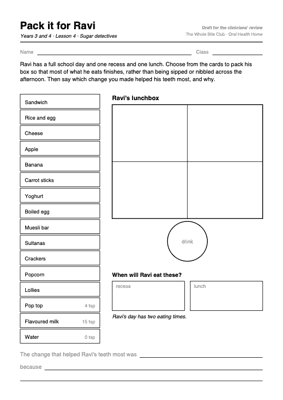
Worksheet: Pack it for Ravi.
45–50
Exit ticket, then the criteria self-check.
Differentiation
Support
Supply the panels already photographed and enlarged with the sugars row highlighted, so the task is the conversion and not the finding. Give a grams-to-teaspoons conversion card. Pre-fill one card into the lunchbox as a worked example.
Challenge
Compare the same drink in two sizes and explain why the per-100 mL figure is the only fair comparison. Extension into AC9M4ST01 (verified): survey the class's drink choices and draw a teaspoon pictograph where one icon is one teaspoon.
EAL/D
The panel is a table, which is a text type in its own right and needs teaching as one: point to the row, the column, the units. Sentence frames for the justification. Every food card carries a picture as well as a name.
Disability
Cards are provided pre-cut on request. Calculator allowed for every student, not only on request. The pictograph extension can be built with physical counters. The game's slider has a keyboard path with arrow-key steps.
Inclusion notes
Read before the lesson runs. These are conditions, not preferences.
Ravi is fictional, and the cards are drawings, not anybody's food. Do not open, photograph, compare or display a real lunchbox in either band.
Keep the card set culturally wide and do not concentrate the sipped-and-nibbled examples in any one cuisine. Say once that nothing on the sheet is a food anyone should stop eating.
Resources
Years 3 – 6 Supporting Resource Pack
One real empty 600 mL drink bottle with its panel intact, for the hook
Enlarged photographs of three nutrition information panels with the Sugars row highlighted, for the support version
Printed Pack it for Ravi sheet with the sixteen food cards, A4, pre-cut sets available
One drink advertisement, print or screen, chosen by the teacher
Rethink Sugary Drink, a partnership of Cancer Council Victoria, Diabetes Victoria and the Heart Foundation · Opened 5 September 2026 · PDF
The teaspoons of sugar shown for each drink. The poster carries its own caveat, that these are estimates and formulations change, and that caveat travels with the figures wherever they appear.
World Health Organization · Opened 5 September 2026
The free-sugars ceiling as a share of what a person eats in a day, which is where the teaspoon arithmetic in the drinks lessons starts. It publishes no separate figure for children, which is why the six teaspoons are attributed to the dental association instead.
Food Standards Australia New Zealand · Opened 5 September 2026
What the Sugars row on an Australian panel is: the total, counting both the sugar already in the food and the sugar added to it. It is the regulator's own statement of the requirement the lesson teaches students to read.
Food Standards Australia New Zealand · Opened 5 September 2026
That an Australian panel still need not break added sugar out on its own line, and when that was last decided. The proposal to require it was assessed and closed on 23 March 2026, leaving the total-sugars declaration as it was.
The figures on the slides
Every figure this lesson puts on a screen, and where it came from. The presenter names each one at the foot of the slide that shows it.
Sugar figures from Rethink your drink, Rethink Sugary Drink, a partnership of Cancer Council Victoria, Diabetes Victoria and the Heart Foundation. Poster artwork dated 22 August 2016. Please note these are estimates only, different flavoured drinks may vary. Always look at your nutrition labels for more accurate information.
Content
Introduction
Hold up a real empty 600 mL bottle and ask: where on this package is the sugar hiding? Take guesses onto the chart before showing the panel.
Name the two skills for today: reading the panel, and reading the front of the pack.
Body
The three rows that matter
Serve size, Sugars per serve, Sugars per 100 mL. Point at each row on a real panel; a panel is a table, and reading a table is a skill of its own.
The Sugars row is the total. Australian panels are not required to declare added sugar separately, so it includes the sugar already in the fruit or the milk.
Grams into teaspoons
Read the grams and divide by four. Let two students check the division on the board using the rows that divide exactly: 64 → 16, 36 → 9, 28 → 7.
Say that the other rows are rounded to the nearest teaspoon, and that rounding a measurement is normal rather than a fudge.
Serve or bottle
A panel gives sugar per serve and per 100 mL, and the serve the manufacturer chose is very often smaller than what a person drinks in one sitting. Find the serve size, check how many serves are in the container, then multiply.
This is not a trick and it is not illegal. It is a decision about which number to make prominent, and noticing it is exactly what AC9HP4P09 asks for.
Front and back
A label's back is regulated and its front is marketing, and the two can be true at once and still tell different stories. Ask three questions of any drink advertisement: who paid for it, what do they want you to do, and does the panel on the back agree.
Keep the tone analytical, not outraged. Students are learning to check, not to be angry.
Worksheet: Pack it for Ravi
A design brief about things that finish rather than things that get sipped for an hour, for a fictional child. No real lunchbox is opened, and there is no target teaspoon score.
Conclusion
4 grams is 1 teaspoon, check the serve and then the bottle, and ask who is talking.
No drink in this lesson is called bad. Water is named as the best drink for teeth because it has no sugar and no acid and it rinses the mouth.
Ask which drink in your house you will check tonight.
ACARA does not endorse any product that uses the Australian Curriculum or make any representations as to the quality of such products. Any product that uses material published on this website should not be taken to be affiliated with ACARA or have the sponsorship or approval of ACARA.
Cross-curricular
Content descriptions from other learning areas, taught alongside this lesson rather than claimed as its alignment.
AC9M4ST01MathematicsOptional
acquire data for categorical and discrete numerical variables to address a question of interest or purpose using digital tools; represent data using many-to-one pictographs, column graphs and other displays or visualisations; interpret and discuss the information that has been created
ACARA does not endorse any product that uses the Australian Curriculum or make any representations as to the quality of such products. Any product that uses material published on this website should not be taken to be affiliated with ACARA or have the sponsorship or approval of ACARA.