The unit closes on protection, in three layers: the daily guard, done properly; the sport guard, and not only for football; and the emergency plan for the first minutes after an adult tooth is knocked out. Students then make something another person can use. This is the band's highest-value content: these students play sport, and the correct action when a tooth is knocked out is counterintuitive.
Learning intention
In this lesson, we will learn the three ways we protect our teeth, and make something that helps someone else.
Success criteria
I will know I am successful when I can:
I can brush for two minutes, reaching the gum line and every surface, and say why we spit and do not rinse.
I can name three sports where a mouthguard is worth wearing.
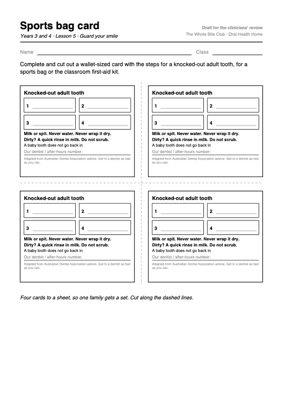
I can make a card that gives the steps for a knocked-out adult tooth, in the right order.
Guiding questions
Why does toothpaste keep working after you have finished brushing?
Netball is not a contact sport. Why would you wear a mouthguard?
Someone's tooth is on the ground. What do you do first?
Vocabulary
gum line — where the tooth meets the gum
mouthguard — a soft shield worn over the teeth for sport
crown — the smooth white top of a tooth
root — the part of a tooth that sits in the gum
socket — the hole in the gum a tooth sits in
Lesson plan
45 to 50 minutes.
0–3
Intention and the three criteria.
3–8
Hook: "Netball is not a contact sport. Why would you wear a mouthguard?" onto the chart.
8–16
Explicit teaching, guard one: every surface, the gum line, two minutes, spit not rinse, and between teeth.
16–21
Game: brush-along (existing timer), the full two minutes, done together.
21–28
Guard two: the sports list, custom against shop-bought, looking after it.
28–36
Guard three, as a physical sequence with props before any writing, then the game Tooth Rescue.
36–45
Worksheet: Sports bag card.
45–50
Exit ticket, the criteria self-check, and the certificate slide.
Differentiation
Support
Run the sequence physically with real props first: a tooth model, a cup of milk, a cloth. Give the four steps as pre-cut picture cards. The card's writing gaps accept drawings.
Challenge
Write and film a 30-second first-aid demonstration for the school's sports teams, and decide where it should be shown.
EAL/D
Every step is a picture before it is a phrase. Pre-teach crown, root and socket with a large diagram. "Knocked out" is idiomatic and gets said plainly once: the whole tooth has come out.
Disability
The brushing demonstration is modelled with a large model and a partner rather than performed in the mouth, and nothing goes in any child's mouth. The card is available pre-printed with the steps for students who cannot write four boxes in the time, so every student leaves with a usable card.
Inclusion notes
Read before the lesson runs. These are conditions, not preferences.
Never imply that a child without a custom mouthguard is being failed, and never mention cost in front of the class.
Not every family has a dentist to write on the back of the card, so the blank line is optional and the class also writes the public dental service number. Do not require any home resource.
Resources
Years 3 – 6 Supporting Resource Pack
A large tooth model and a toothbrush for the demonstration; nothing goes in any child's mouth
Props for the emergency sequence: a model tooth, a cup, a cloth
Printed Sports bag card sheet, four cards per A4, plus a pre-printed set for students who cannot write four boxes in the time
A mouthguard to pass around, if the school has one
The public dental service number, written up for the back of the card
The first aid for a knocked-out adult tooth: hold it by the top, put it back if you can, keep it in milk if you cannot, and never put a baby tooth back.
Australian Dental Association · Opened 5 September 2026
What to do with a knocked-out adult tooth, in the order the page gives it: if it is dirty, one gentle rinse and never a scrub; back in the socket straight away; and, where it cannot go back, it travels in milk or the person’s own spit, never in water, in the page’s own words "Put the tooth in milk or your child's saliva to transport it to the dentist as soon as possible".
Australian Dental Association · Opened 5 September 2026
That a mouthguard is worn for training as well as for games; that a growing mouth is what ends a mouthguard's life, so one that fits today needs its fit checked while a child is still growing; and, in the page's own key messages, that the best-fitting one is made by a dentist — "A mouthguard custom made by a dentist will provide the most protection for the teeth and mouth". No replacement interval, because the page states none.
Why the teacher note tells a class that bleeding gums are inflammation rather than a reason to leave the spot alone: the page names bleeding gums as a symptom, explains the inflammation as the immune system's response to plaque, and says not to stop brushing.
Metro North Health, Queensland Health · Opened 5 September 2026
What Queensland's own school dental service tells families: brush morning and night, the strength of toothpaste to look for, and how to book a check-up. It is the state service the visit sits alongside.
Fouad AF and others, Dental Traumatology, 2020, read from a Wayback snapshot · Opened 5 September 2026
The timing behind the first aid, for the teacher note rather than the slide: how long a knocked-out adult tooth can be out of the mouth, and why milk or the person's own spit buys time that a dry pocket does not.
Cochrane Database of Systematic Reviews, April 2019 · Opened 5 September 2026
Why cleaning between teeth is taught as reach rather than as proven cavity prevention: a brush cannot get between two teeth that touch, and no trial in the review measured decay between them.
The figures on the slides
Every figure this lesson puts on a screen, and where it came from. The presenter names each one at the foot of the slide that shows it.
Adapted from Australian Dental Association advice on dental trauma, and from Better Health Channel, Dental injuries.
Content
Introduction
Ask the hook: netball is not a contact sport, so why would you wear a mouthguard? Take answers onto the chart before the list is read.
Name the three guards now, so students know the shape of the lesson: every day, on the field, and in an emergency.
Body
The daily guard
Twice a day, two minutes, every surface, and along the gum line, gently. Brushing harder is not better and it does not clean more. From six, you use the regular family toothpaste, not the little-kid kind: give the boundary and no amount, because no source here gives one.
Spit, and do not rinse — rinsing washes away the part of the toothpaste that would keep working. A toothbrush cannot reach between two teeth that touch, so something else has to, once a day.
The sport guard
Read the ADA's own list out loud: cricket, basketball, netball, touch football, skateboarding and soccer, alongside the contact sports. It surprises students who think this is a football rule.
Custom-fitted protects best, and a shop-bought one is much better than none. Say the second half without hedging, and never mention cost in front of the class.
A custom guard lasts several seasons once you have stopped growing, and a growing mouth changes shape, so the fit needs checking while a child is still growing. State no interval: nothing in this set gives one.
The emergency plan
Find it. Hold it by the crown, never the root. If it is dirty, a quick rinse in milk or your own spit and never a scrub. Back in the socket the right way round, straight away, and bite gently on something soft. If it will not go back, put it in milk or your own spit — never water — and go straight to a dentist.
Run it as a physical sequence with props before any writing. A knocked-out baby tooth never goes back in.
Worksheet: Sports bag card
Four cards per sheet so one family gets a set. Mark the step order first and the wording second.
Conclusion
Twice a day and between; a mouthguard for anything with a ball or a board; crown, milk or spit, and straight to a dentist.
Hand back the lesson 1 charts so students can see what they knew at the start.
Which part of a knocked-out tooth do you hold: the crown or the root?
Application
Your friend's adult tooth is knocked out at lunch and there is no milk anywhere. Name two things you can do straight away.
Assessment
Assessment of learning
The card is the band's second summative piece and is marked on step order. Students then self-assess their two-minute brushing against the three-surface criterion.
Rubric for Guard your smile
Criterion
Working towards
At standard
Above
Gives first aid steps for a knocked-out adult tooth.
names two of the four steps
gives all four steps in the right order, including milk or spit rather than water
does that and can say why the root must not be touched
Curriculum links
AC9HP4P08Year 3 and 4
describe and apply protective behaviours and help-seeking strategies in a range of online and offline situations
AC9HP4P10Year 3 and 4
investigate and apply behaviours that contribute to their own and others' health, safety, relationships and wellbeing
ACARA does not endorse any product that uses the Australian Curriculum or make any representations as to the quality of such products. Any product that uses material published on this website should not be taken to be affiliated with ACARA or have the sponsorship or approval of ACARA.