
2 to 3 years
All twenty teeth
All 20 baby teeth are in by 3. This is the year to let the dummy go.
This month
- Make a plan for the dummy.
- The night brush, every night.
- Sometimes food, not every day.
- Grate or cook carrot and apple.
- Lift the lip once a month.
- Floss where two teeth touch.
By 3, all 20 baby teeth are in. The front ones stay until about 6. The back ones stay until about 12.
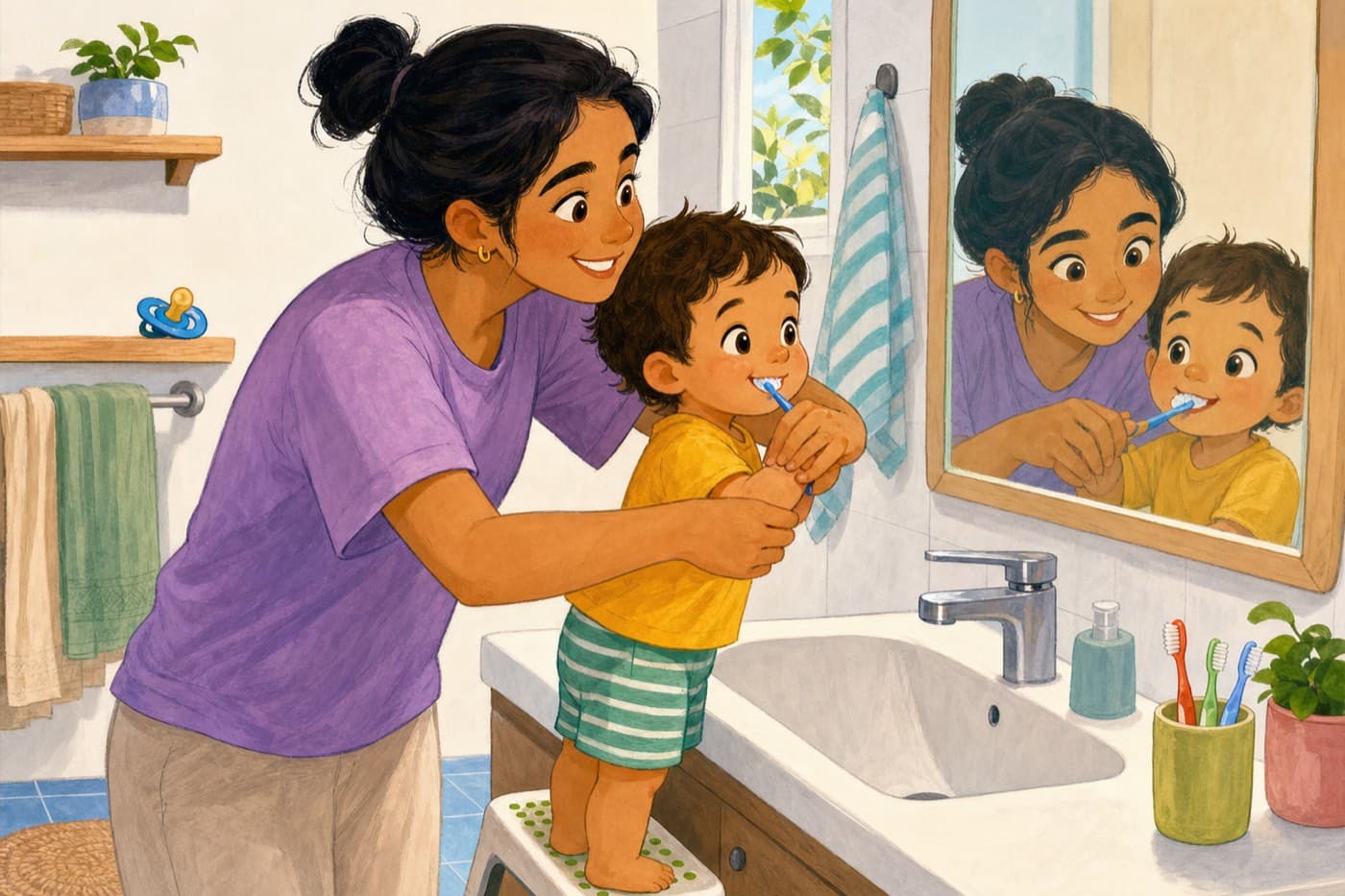
Brush morning and night. The night brush is the important one. Your child can have a go first. You finish. That stays true until about 8.
Time to let the dummy go. Most kids stop between 2 and 4. Keep it for sleep first, then say goodbye.
Thumbs are harder. Praise the times the thumb is out. Do not fight over it.
Sweet or sticky snacks are for sometimes. Fruit, cheese and soft cooked vegetables are for every day. Grate or cook hard ones like carrot and apple until your child turns 3.
When two teeth touch, a brush cannot get between them. Ask us to show you how to floss.
Lift the lip once a month. Ask your child health nurse to look at every routine check too.
When to get help
- A swollen face is not something to wait on. Nor is a fever with a sore tooth. See a dentist or doctor today.
- Call 000 if your child cannot breathe or swallow, or the swelling is spreading fast.
- Not sure? Ring 13 HEALTH on 13 43 25 84, any time of day or night.
Register your child
Tell us who your child is and where they go. We will check their teeth when we visit.
Sign up todayWhere this comes from
We checked every line on this page against these.
Teeth development in children(opens in a new tab)
Better Health Channel · Opened 5 September 2026
That children grow two sets of teeth, roughly when each adult tooth arrives, and that baby teeth hold the space the adult teeth need.
Toothbrushing – children 0-6 years(opens in a new tab)
Better Health Channel · Opened 5 September 2026
Brushing twice a day, about two minutes, every surface and along the gum line, and spitting the toothpaste out rather than rinsing it away.
Dental Care For Kids(opens in a new tab)
Australian Dental Association · Opened 5 September 2026
That cleaning between teeth starts once two teeth touch, which is why a brush on its own is not the whole job.
How children develop: food and nutrition (1 to 5 years)(opens in a new tab)
Queensland Government · Opened 7 September 2026
That hard raw vegetables such as carrot are not given to a child under three, and that hard fruit such as apple is cooked or grated until then, because both can choke a small child.
Kids Health Info: Safety: Choking, suffocation and strangulation prevention(opens in a new tab)
The Royal Children’s Hospital Melbourne · Opened 7 September 2026
That carrot, apple and other hard fruit and vegetables are cooked, mashed, peeled or grated for a small child, because a child under three may not have a full set of teeth to chew them with.
Talking to kids about the foods we eat and why(opens in a new tab)
Health and Wellbeing Queensland · Opened 5 September 2026
Everyday and sometimes as the words for food, and why the lessons use them: they describe what a food does without calling it good or bad, which is the whole point of the sorting activity.
Better Health Channel · Opened 7 September 2026
That sucking a dummy is normal, that most children stop between two and four, that a long habit changes the teeth and jaws, and that a dummy is never dipped in anything sweet.
Thumb sucking(opens in a new tab)
Better Health Channel · Opened 7 September 2026
That most children stop sucking a thumb between two and four, that a habit which carries on can push the teeth out of place, and that praise and reminders work better than a fight.
Tooth abscess(opens in a new tab)
healthdirect Australia · Opened 7 September 2026
That a swollen face or a fever with a sore tooth is seen the same day and does not settle on its own, and that swelling which reaches the neck or mouth is an emergency.
Text alternative: Lift the lip poster(opens in a new tab)
NSW Health · Opened 7 September 2026
Once a month as the frequency for a parent's own look, and the two things it turns up: white lines along the gum line, which are booked now, and brown or yellow spots that do not brush off, which are urgent. No Queensland page states a frequency.
Dental health & dental care for toddlers(opens in a new tab)
Raising Children Network · Opened 7 September 2026
Brushing a toddler's teeth morning and night, letting the child go first and the adult finishing, and that a parent keeps helping until about eight.
Food and drinks for children(PDF, opens in a new tab)
Australian Dental Association · Opened 7 September 2026 · PDF
Milk and water as the drinks, a cup rather than a bottle after one, and that sticky or sweet snacks sit on the teeth longest.
Tooth eruption charts(PDF, opens in a new tab)
Australian Dental Association · Opened 7 September 2026 · PDF
The order and the months the twenty baby teeth arrive in, that a child is seen by one however many teeth are there, and that the first ones start to go at about six.
Questions? admin@oralhealthhome.com